

Sak Yant Myths & Misinformation
Separating Traditional Thai Tattoo Fact from Fiction
Sak Yant tattoos are surrounded by myths, many of which come from travel blogs, outdated sources, or commercial tattoo websites. While these stories can be entertaining, they often misrepresent the history, techniques, and spiritual meaning of Sak Yant. Understanding the difference between myth and reality is essential for anyone considering this traditional practice.
Sak Yant Myths and Misinformation. Get the Truth - Sak Yant Information Guide Expert and Real Sak Yant Information
Table of Contents
ToggleWhere Do Sak Yant Myths Come From?
1) Travel Bloggers & Tattoo Shop websites

Much of the misinformation surrounding Sak Yant comes from two main sources: travel blogs and commercial tattoo websites.
Travel blogs often focus on storytelling rather than accuracy. Many writers experience Sak Yant once and then attempt to explain complex traditions without fully understanding the language, history, or cultural context. As a result, information is frequently simplified, misunderstood, or repeated from other inaccurate sources.
Tattoo shop websites, on the other hand, may present Sak Yant in a way that aligns with their services. This can lead to explanations that focus on aesthetics or convenience, rather than the traditional process and meaning behind the tattoos.
Over time, these repeated inaccuracies create widely accepted myths that can be difficult to distinguish from reality.
Typical Sak Yant Mistakes from Bloggers and Tattoo Shops
Travel Blogger Created Mistakes
If a Blog Post about a Sak Yant contains any of the following claims … It is a inaccurate article
- A Sak Yant is by donation of whatever you think appropriate
- The Inks contain ingredients like henna or snake parts that makes allergic reactions a possibility
- There is only ONE place to get a Sak Yant in a given city
- A real Monk can not touch a women so females can not get Sak Yants from Monks
- Sak Yants are done with a Bamboo Needle
- Needles and Ink is reused for many people
- You need to follow strict rules after getting a Sak Yant
- The Monk or Ajarn chooses the design
- Monks can read Auras
Tattoo Shop Created Mistakes
If a Tattoo Shop Website about a Sak Yant contains any of the following claims … It is to appeal to naivety of Tourists
- You don’t really need the magic aspect of the Sak Yant
- They make prettier looking designs
- They have Air-conditioned rooms
- Real Sak Yants are unhygienic using old needles and ink
- Thai People will praise you for having fakes because they look good
- Real Sak Yant Masters can’t accept Money
- They have no ethical issues going against Thai Culture – so why should you?
- Real Sak Yants are not available in the areas they operate in
- and so on and so on
Got Sak Yant Questions?
We have the Answer at our Sak Yant FAQ
Sak Yant Information: Myths and Misinformation Corrected

There are several recurring myths that appear across blogs, forums, and commercial websites.
These include ideas such as:
- Sak Yant tattoos are always free or donation-based
- The ink contains exotic or dangerous ingredients
- Monks choose designs based on a person’s “aura”
- Bamboo needles are the traditional method
- All Sak Yant tattoos follow the same rules and practices
While some of these claims may have elements of truth in specific contexts, they are often oversimplified or presented without proper explanation.
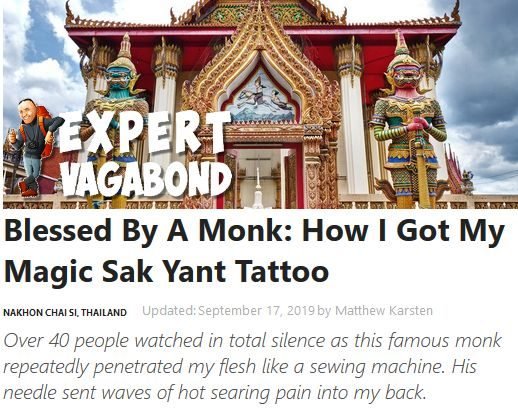
Many of the Sak Yant Myths and Misinformation are created and copied from the Expert Vagabond websites article ‘Blessed By A Monk: How I Got My Magic Sak Yant Tattoo’, this article will list and correct some of the misconceptions found on that blogpost and others.
Some are important, others are just a result of insufficient knowledge or research. The author himself acknowledges how he learned about the Sak Yant .. “Traveling around Southeast Asia while living out of my backpack, I learned about these tattoos from some fellow travelers and thought it sounded like a cool experience”. It is not really the best source to learn about traditional and sacred rituals of a country from someone promoting budget experiences he learns from backpackers.
1) Sak Yant Myth - Origins of the Sak Yant are Buddhist Monks
Misconception: “Buddhist monks originally engraved Sak Yant into warriors seeking protection and strength in battle. Often covering their entire bodies from head to toe in magic symbols to prevent knives and arrows from piercing their skin”
Reality:
The practice predates its association with monks and is rooted in earlier spiritual traditions. Over time, as literacy and religious education became centered in temples, monks and Ajarns became key figures in preserving and passing on the knowledge.
Today, Sak Yant is closely linked with Buddhism in Thailand, but its origins are more complex and influenced by multiple belief systems. You can Read more History of Sak Yant Tattoo
2) Sak Yant Myth - Poke method Vs Machine Tattoo
Misconception: “No machines are used to create a Sak Yant design. These traditional Thai tattoos are engraved into the skin with a long metal spike or bamboo sharpened to a point”.
Reality:
In practice, metal rods have long been used, and modern tools may also be incorporated depending on the master. The term “bamboo tattoo” is largely a modern label that describes a technique, rather than the cultural or spiritual practice itself.
As noted in community discussions, even experienced practitioners point out that the “bamboo” association is often misunderstood or simplified
Many Monks and Sak Yant Ajarns use modern tattoo machines in addition to the poke method. Bamboo has not really ever been used as Thailand Temples have had and used metal for over 1000 years.
3) Sak Yant Myth - The Monk chooses the design based on Auras?
Misconception: “Monks will often choose a sacred design, as well as the location of your tattoo based on your aura“.
Reality:
While a master may offer guidance, traditional Sak Yant does not rely on aura reading. Instead, the design is typically chosen based on intention, meaning, and discussion between the individual and the master.
The placement of the tattoo is also usually determined by the design itself rather than mystical interpretation.
4) Sak Yant Myth - Best Place to get a Sak Yant Tattoo
Misconception: “The best place in Thailand to receive a Sak Yant tattoo is a Buddhist temple called Wat Bang Phra. It’s located about 40 minutes West of Bangkok.”
Reality:
In reality, Sak Yant is practiced by many masters across Thailand, each with their own lineage, techniques, and traditions. What is considered “best” often depends on personal preference, experience, and the type of Sak Yant being sought.
For example the Wat Bang Phra Lineage is about 80 years old. Masters in Northern Thailand have a Lineage history 8-10 times longer, with hundreds of additional Sak Yant Designs.
5) Sak Yant Myth - Sak Yant Ink Contains Exotic Ingredients
Misconception: “Each monk concocts his own special blend of magic tattoo ink too. The recipe is secret, but is thought to contain Chinese charcoal, snake venom, palm oil, and even human remains!”.
Reality:
While historically natural materials may have been used, modern Sak Yant ink is typically sourced from standard tattoo supplies. In some cases, small amounts of specially prepared or blessed ink may be added, but the more extreme claims are largely exaggerated.
A starter Ink that has been made using some additional herbs and prayed over is often added in small quantities.
6) Sak Yant Myth - The Sak Yant Hygiene?
Misconception: “The safety of Sak Yant is debatable. It can be a risky practice. The needle itself is usually wiped with an alcohol pad after each tattoo. Or it might be placed in a bottle of alcohol while a separate needle is used for the next person. But the same pot of ink is used with everyone, and blood can mix with the ink”.
Reality:
Another common concern is hygiene, with claims that needles and ink are reused.
Standards do not vary depending on location, most reputable Sak Yant practitioners today use modern hygiene practices, including new needles and proper sanitation.
This situation was reported in a single blogpost where the author decided not to give the Monk enough money to cover the cost of ink and needles. So they go used ones.
7) Sak Yant Myth - Sak Yant Tattoos Are Free
Misconception:“Outside the entrance, I purchased a temple offering consisting of orchid flowers, incense sticks, and menthol cigarettes for 75 baht ($2.40 US) before removing my shoes and heading inside. Everyone is expected to present these simple gifts to the monk as payment for a Sak Yant tattoo”.
Reality:
The idea that Sak Yant tattoos are always free or based purely on small offerings is a misunderstanding.
Traditionally, offerings are made as a sign of respect, but this is separate from the contribution given for the tattoo itself. The amount can vary depending on the master, location, and experience. You just need to ask!
You can find out more in Why Sak Yants are NOT Free
8) Sak Yant Myth - Real Monks can't touch a women or female?
Misconception:“Monks can not touch a female or women, therefore a Monk can not give a Sak Yant to a Female”.
Reality: There are no rules that say Monks can’t touch a female or women. There is however a Sanhadusesa rule (guidelines for living in a Monastery) that is often used as the foundation of this myth. The problem tends to be that people quote only half of the rule (actually half of the sentence) without any context or fact Checking
The saṃghādisesa 2 says “yo pana bhikkhu otiṇṇo vipāriṇatena cittena mātugāmena saddhiṃ kāyasaṃ saggaṃ samāpajjeyya hatthaggāhaṃ vā veṇiggāhaṃ vā aññatarassa vā aññatarassa vā aṅgassa paramasanaṃ saṃghādiseso.”
The saṃghādisesa 2 Not to touch a woman. If, with a lustful mind, a bhikkhu touches a woman – even a female born on that very same day – or the hair of a woman (not cut), it entails a meeting of the saṃgha.
So there is no rule that prohibits monks from touching women. The sanghadisesa rule is designed to keep focus on Spiritual mind while in Temple grounds by prohibiting monks from sexually groping women with “mind overwhelmed by lust”. For a monk to touch a woman with no lustful intent or outside of the Temple is not an offense. This does however mean that a Monk will not preform a Sak Yant Tattoo for females in Temple grounds, but they are able to do this off Temple.

9) Sak Yant Myth - Hand Poke Bamboo Needle Tattoo are Sak Yant?
Misconception:“Almost every website reference to Sak Yant Tattoo’s that are made by travel bloggers or commercial Tattoo Shops will mention Bamboo Needle or Bamboo Tattoo. This leads people to get the impression a traditional hand poked Tattoo using Bamboo (Needle or stick) is the same thing as a Sak Yant.
Reality: This myth is around 20 years old and was started by incorrect western media terming the Sak Yant a “Bamboo Tattoo”Bamboo tattooing was never a thing in Thailand, there are no historical or academic references to this at all when articles talk about the Sak Yant Tradition. A Sak Yant has always been called a Sak Yant by Sak Yant Masters and Ajarns qualified to create them. T
However, Sak Yant is defined not just by technique, but by its designs, scripts, rituals, and blessings. A hand-poked tattoo without these elements is simply a tattoo done in a similar style.
Why Understanding These Myths Matters
Misunderstandings about Sak Yant can lead to unrealistic expectations or confusion about what the experience involves.
For those interested in receiving a Sak Yant, having accurate information helps ensure:
- A clearer understanding of the tradition
- Better communication with the practitioner
- A more meaningful overall experience
If you are considering getting a Sak Yant, it’s important to look beyond common myths and focus on understanding the tradition itself.
Take the time to research different approaches, ask questions, and decide what type of experience you are looking for—whether that is cultural, spiritual, or purely aesthetic.
Want to Get a Real Sak Yant?
Sak Yant Chiang Mai is Thailand’s leading Sak Yant provider – Over 10 Independent Sak Yant Masters working in Hygienic and comfortable Samnaks
